
Welcome to Marketing Chronicles. A monthly dose of strategy and creativity for brands, agencies, and businesses — delivered on the second Wednesday of every month. If you like what you see and you’re not already a subscriber, join us for free.
Hello Marketing Chroniclers. Happy New Year.
As we enter 2026, my challenge to all of you is to start thinking about 2027.
Yes, you read that right! As I describe in one of the sections below, what you choose to do in these first 3-4 months of the year will largely determine how you effective you’ll be in 2027. It’s never too early to start thinking about strategy.
Drop me a line on LinkedIn if anything stands out to you!
Enjoy 🧠
This edition is supported by Tracksuit, a beautiful, affordable, always-on brand tracking dashboard that helps marketers and agencies prove the impact of brand building.
I’ve always found that setting SMART brand objectives to be difficult without having a clear baseline of where my brands stand — until now. The folks over at Tracksuit have developed an elegant tool that helps you understand how your activities are impacting your brand's health metrics without breaking the bank.

DEPT. OF HISTORY/
The 250-Year Strategy
I think that the American Constitution is one of the most fascinating works of strategy ever written. I know it's not often thought of it that way, but by most definitions of what strategy means, it's a strategic masterpiece.
For some reason, outside of America, the "Founding Fathers" are not seen as intellectuals worthy of admiration. But having spent some time visiting the historic sites in Virginia and Pennsylvania, read several biographies and works of American political philosophy, and most recently watched Ken Burn's PBS American Revolution docuseries, I can't help but to be amazed by their prophetic foresight.

“The American Revolution” by Ken Burns, Sarah Botstein & David Schmidt (2025).
10 pages. 4,400 words. With the opening for expansion (which it did, now amounting to 20 pages, 8,000 words and 27 amendments) it serves as the strategic backbone for all decisions made by a continental government overseeing the most diverse population in the world.
In business we struggle to write 3-year strat plans, now imagine as 250-year document that still holds true to this day. That's no easy feat.
No matter how much it bends, gets attacked, or misinterpreted, the Constitution always brings every debate back to its foundational truths. That's a strategist's dream.
The fact that it was written by 55 delegates in a convention is what makes it even more fascinating. In strategy there's a common pitfall that wrecks plans, which is when the document is written by committee. It dilutes the intent of the plan, and oftentimes becomes a Frankenstein-ish document unrecognizable from the rest. But somehow, this was not the case with the Constitution.
Despite its original flaws, the Constitution did leave a door open for amendments, but the process to doing so is a rigorous one. I believe these sorts of works are worthy of strategist's attention because it's easy for us to get tunnel vision in existing fleeting pieces of strategy that work in the short-term but don't hold for long.
As someone who was born in Brazil and naturalized Canadian, I find similarly fascinating pieces of strategy in my other nations, but seldom do they reach the level of simplicity and clarity that the U.S. Constitution does.
DEPT. OF CREATORS/
How To Think Better
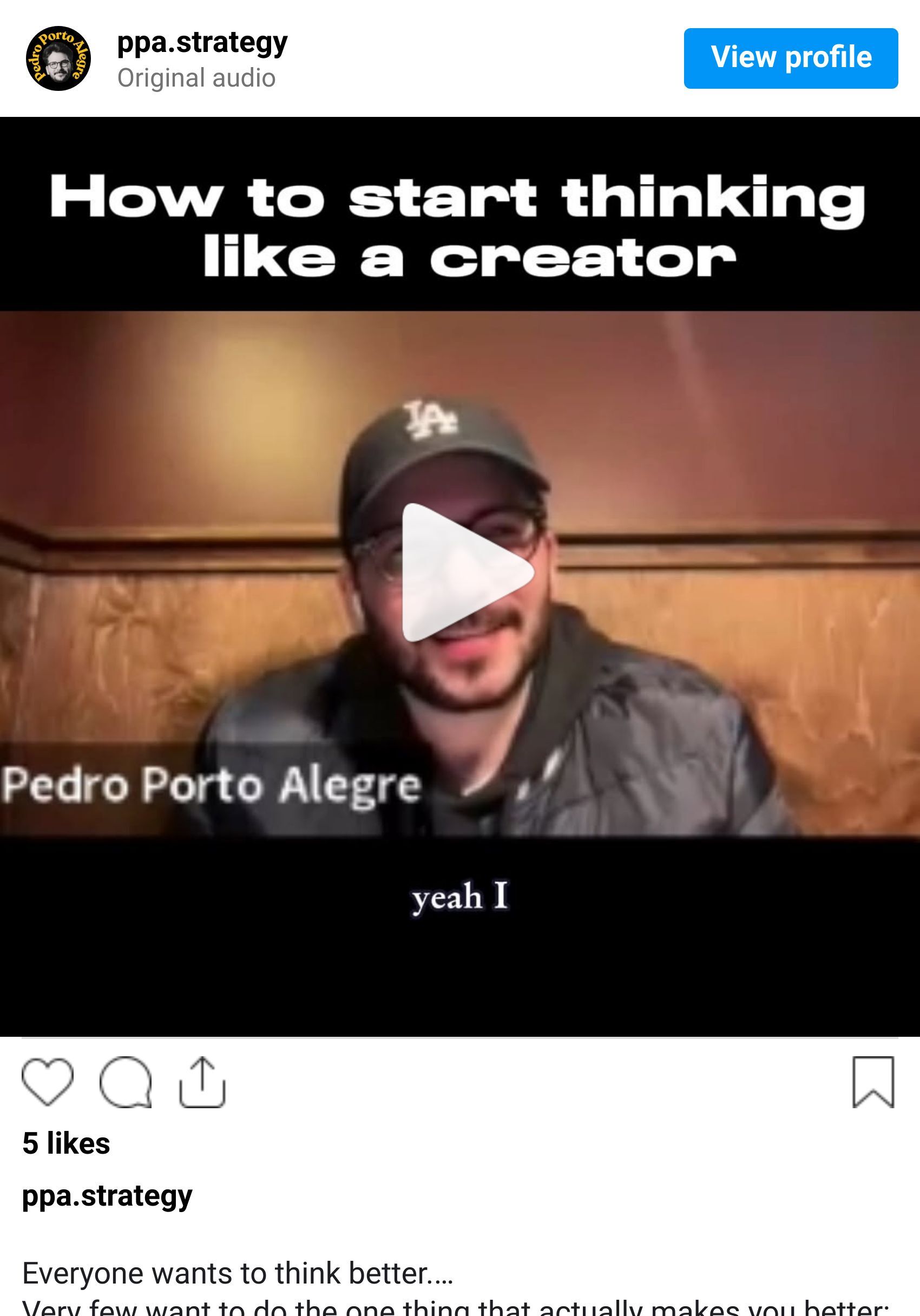
Everyone wants to think better. Very few want to do the one thing that actually makes you better: Articulate your thinking. Over and over again.
Out loud. In public. In writing. On video.
Reps. Reps. Reps.
In the clip below from last November’s APG Canada ‘Grow Your Brain’ showcase, we talked about a simple truth people in strategy still underestimate:
You don’t get enough practice on the job.
A couple dozen briefs a year, if you're lucky.
That’s not enough to meaningfully improve the clarity, sharpness, and structure of how you think.
But the internet? The internet gives you infinite at-bats.
Post a thought. Record a 30-second idea. Break down something you noticed on a walk. Write three hooks. Try again the next day.
When you articulate your thinking often, something changes:
Your arguments get cleaner.
Your ideas get tighter.
Your communication becomes faster, sharper, more instinctive.
Your strategic thinking stops living only in your head.
You accelerate your leaning on the job because you’ve already done the work elsewhere.
I love the line from Jason Murray:
“You want your own experience to be ahead of your job experience.”
That’s it. That’s the whole game. Because the people who get good at strategy aren’t necessarily the ones who read the most. They’re the ones who practice expressing what they think. Daily, consistently, even when it’s 11pm and the house is asleep.
If you want to think better, start talking. Start writing. Start shipping.
There is no better teacher than doing.
A.I./
Stop Treating AI As A Cost-Saving Tool
I was recently listening to Rory Sutherland on the IPA (Institute of Practitioners in Advertising) Making Sense podcast, and he made a point that’s been echoing in my mind ever since.
Most companies will deploy AI in the least imaginative way possible: to cut costs.
Not because AI is inherently a cost-cutting technology, but because cost savings are the easiest thing to sell… and the easiest thing to justify.
AI vendors pitch, “This will save you money.”
Executives say, “Look at the money we saved.”
And just like that, the first wave of AI adoption becomes a race to automate tasks and trim headcount.
It’s measurable. It’s immediate. And it’s depressingly unimaginative.
Meanwhile, the real value of AI isn’t in replacing people. It’s in augmenting them. Creating new forms of value. Enhancing experiences. Expanding what the business can do, not just what it can cut.
AI is a force multiplier when it’s used with ambition, not austerity. Rory articulated it perfectly: the biggest missed opportunity will be companies treating AI like a cost-saving tool instead of a value-creating one.
DEPT. OF PLANNING/
Why Q1 Is The Most Important Time of Year For Marketers
Instead of speculating about AI revolutions or channel-of-the-year trends, I want to share the 6 non-negotiables marketers must get right in 2026. These are the fundamentals that often get overlooked or cut out of budgets.
And if you don't do them, no amount of "shiny objects" will save the year.
Because here’s the uncomfortable truth:
Most marketing plans collapse not because the ideas are weak, but because the foundations are.
☠️ Outdated consumer research.
☠️ Planning done entirely from meeting rooms.
☠️ Brand metrics checked once a year like a doctor’s appointment.
☠️ No grasp of ESOV realities.
☠️ Tactics before strategy (always fatal).
And yes, brand tracking treated as a luxury instead of an operating system.
This is why I love modern brand tracking platforms like Tracksuit. They make continuous brand health something teams can actually action against, not something they dust off once a year as a check the box activity.
None of this is particularly "shiny" or "revolutionary."
But marketers that master the fundamentals are the ones who rise above.
2026 is already here. It's execution time.
But what you do in the next 4 months will largely determine how your 2027 will go.
DEPT. OF PLANNING/
The 4 Key Questions You Should Have Answers For
If you're a marketer trying to learn more about a category you're unfamiliar with, there are 4 key questions you should get answered before anything else.
Far too often I see category analyses based on "vibes."
Looking at creative on social, reading online articles, or relying on social sentiment to extrapolate assumptions.
That should be the final mile of an analysis. The bulk of it can be derived from the following 4 areas of investigation:
🔎 How often do buyers buy the category? This will tell you about the length of the sales cycle, share of heavy vs light category buyers, and help you estimate the total attainable market for any given year.
🔎 How many brands do people buy from? This is about understanding consumers' repertoires, and whether your category tends to lean towards high-loyalty vs low. You can go one step further and run a duplication of purchase analysis to understand who are the true substitutes to your brand.
🔎 How do shoppers shop the category? This is about understanding media dynamics and outsized pockets of distribution importance. If you don't understand where you should be showing up in the "moment of truth", then nobody will find you.
🔎 Is the category growing? The product category lifecycle will tell you whether or not you're competing in an emerging, growing, mature or declining category. And depending on where you are in the curve, the strategy for growth changes.
These questions cannot be easily answered through secondary research.
One must commission primary quant research to get to these, because internal data will naturally be skewed.
SOCIAL MEDIA/
A common mistake I see marketers commit when evaluating brand equity is solely looking at empirical digital signals to draw insights.
9 times out of 10, online social sentiment is irrelevant.
Why?
Because online chatter is heavily biased toward extremely positive or extremely negative experiences or isolated events.
By now it's a well document fact that social engagement has no correlation with business results. And that can be explained by the Rule of Unequal Participation: 90%+ of all online engagement comes from less than 5% of users. Most people online are "lurkers".

Which is also why 5-star and 1-star Amazon reviews are the worst types of reviews because they are either about the product/delivery service meeting expectations or about some isolated negative experience from someone who is accustomed to engaging online. All nuanced "true" reviews are a minority.
It's also worth remembering that most online sentiment lacks statistical representation. The internet is a global parallel universe, all local nuance gets watered down in this mix (unless there's an actual regional topic driving conversation).
A perfect example of this was the whole American Eagle chapter this year. LinkedIn chatter was brutally negative. Business results exceeded all expectations.
If you run an actual statistically representative survey with consumers, you'll find social sentiment to be completely disconnected from reality.
So, what should we use social sentiment for? Pre-testing changes to your brand to check buyer acceptance. Sourcing ideas for product innovation. Pre-testing new launches with an audience likely to buy first. Gathering feedback around ideas from a loyalist audience. Etc.
This is mostly a qualitative layer to your research than anything else. You still got to then go and test your findings in the "real world."
Always take all online chatter with a grain of salt!

Online chatter rarely reflects offline reality.
INSPIRATION/
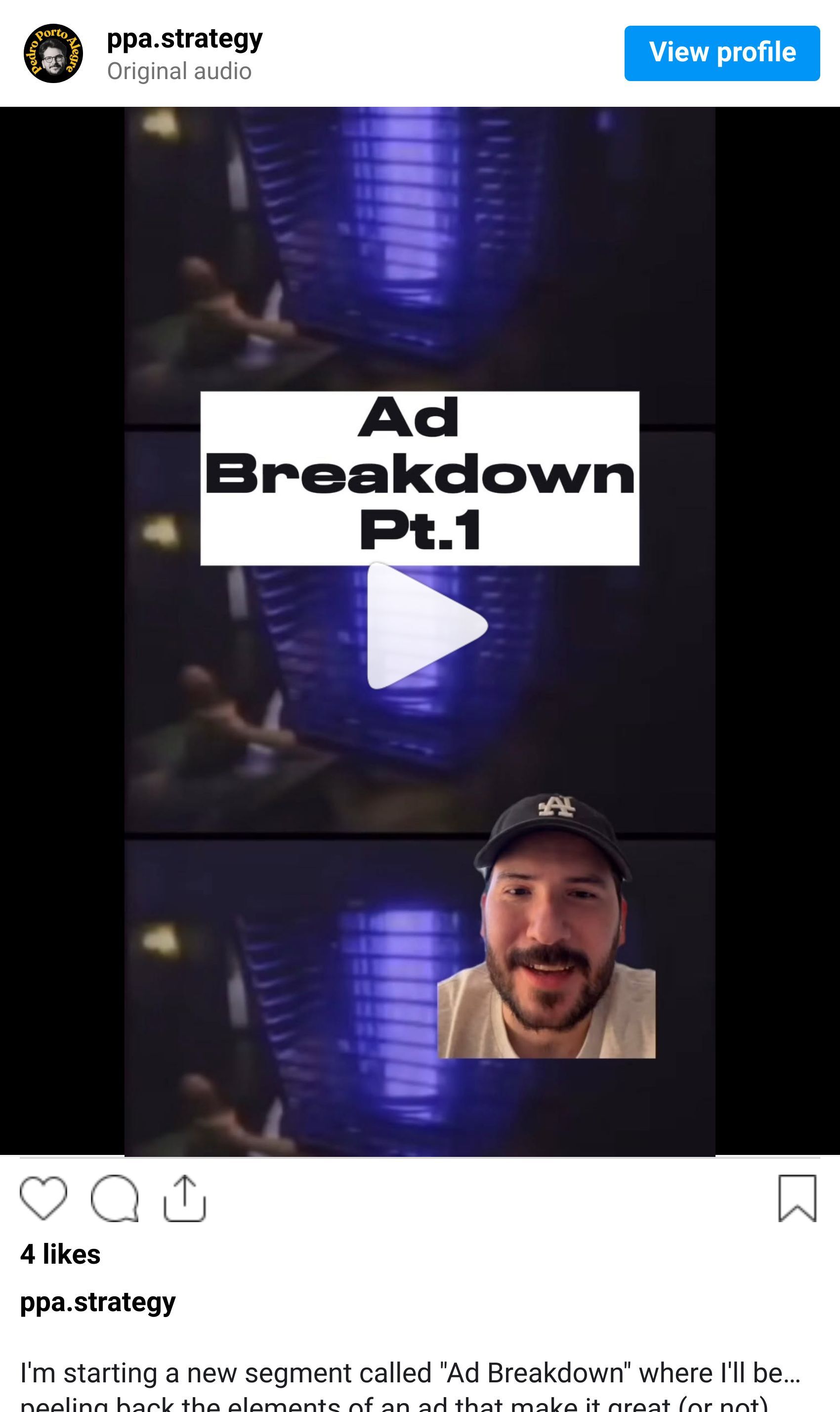
Tabasco Mosquito Super Bowl Commercial (1998)
Simple concept. Interesting hook, clever ending. Funny story line that conveys a key product feature. Branded from the start. Usage of sonic distinctive brand asset. Affordable production.
Gold standard advertising.
BRAIN FOOD/
Strategist’s Delight (What’s On)
Book: Upheaval: Turning Points for Nations in Crisis (Jared Diamond)
Podcast Episode: The IPA Making Sense Podcast: Rory Sutherland (IPA)
TV Show: The New Yorker At 100 (Netflix)
Article: Aphoristic Intelligence Beats Artificial Intelligence (The Atlantic)
QUOTE/
“An intellectual says a simple thing in a hard way. An artist says a hard thing in a simple way.”
More of PPA:
🗣 For speaking engagements, you can reach me at [email protected]
PPA
Pedro Porto Alegre is a seasoned marketing strategist with in-depth experience building brand and communications strategies for top-tier B2C and B2B organizations across North America. His repertoire extends from crafting and executing integrated multi-media brand marketing campaigns to the commercialization of performance-driven innovations for multimillion-dollar and nascent brands alike.
