
Welcome to Marketing Chronicles. A monthly dose of strategy and creativity for brands, agencies, and businesses — delivered on the second Wednesday of every month. If you like what you see and you’re not already a subscriber, join us for free.
Hello Marketing Chroniclers. The end of the year is near, and 2026 is just around the corner. This means that if you’re a marketer, you should be thinking about how to get off to a fast start in Q1.
So, this month I will leave you with some thought provoking ideas as you wrap up 2026 planning and gear up for your best year yet.
Drop me a line on LinkedIn if anything stands out to you!
Enjoy 🧠
This edition is supported by Tracksuit, a beautiful, affordable, always-on brand tracking dashboard that helps marketers and agencies prove the impact of brand building.
I’ve always found that setting SMART brand objectives to be difficult without having a clear baseline of where my brands stand — until now. The folks over at Tracksuit have developed an elegant tool that helps you understand how your activities are impacting your brand's health metrics without breaking the bank.

RESEARCH/
Creators Are Best Used To Build Future Demand

This famous chart has been updated recently, and it's sending shockwaves across the industry. Creators are neck and neck with TV for long-term brand effects. Wow 🤯
Now, obviously TV remains the ultimate brand building medium given its sheer scale and production value that signals the brand being in good standing, but holy smokes no one thought creators could be punching this much above their weight.
If I'm a creator right now (which I am 😎) I'd be immediately enrolling in Mark Ritson's upcoming MiniMBA to learn the fundamentals of marketing. Content creators will begin having work scrutinized a lot more because of the increased flow of dollars coming their way from brands.
Learning about DBAs and how to integrate them, brand collab synergies, emotional storytelling, how to create effective hooks, etc. are all going to be the lenses by which brand marketers will start measuring them against.
Up until this point marketers would just wave content through from their creators, but assuming brands start pumping more dollars into "people media", they'll need to learn how to "speak marketing" to rise above the rest.
If you want to dive deeper, check out Andrew Tindall's recent column in The Drum. Truly fascinating stuff.
DEPT. OF PSYCHOLOGY/
People Don’t Do What They Say
The term "agile" has been fashionable in business for quite some time now, but there is a lot more nuance to it than meets the eye.
While technology is changing at an unforgiving pace and should be taken into account when doing strategic planning (yes - go chase that AI shiny object, but don't force fit it into your strategy if it doesn't make sense yet), human behaviour still moves at a glacial pace.
Let me explain.
In classic social-psychology there are these models called Theory of Reasoned Action (TRA) and Theory of Planned Behavior (TPB) that have shown that attitudes toward a behaviour influence intentions, and that intentions are among the strongest immediate predictors of behaviour.
However, there's an abundance of evidence out there showing that favourable attitudes don’t always translate into behaviour (also known as the "attitude-behaviour gap"). For example, consumers may say they care about sustainability (attitude) yet not change purchase behaviour accordingly because of the "green premium".

This means that behaviour shifts hinge less on attitudes and more on things like:
entrenched habits
situational constraints (like price, availability, norms, infrastructure)
learning curves and adoption costs, and so on.
Changing behaviour is arguably one of the most difficult things to do. Think about how so many people try to start going to the gym and fail to do so. It's clear to them that it's imperative for their health, and STILL is incredibly difficult to do so.
So, while attitude tracking (consumer sentiment, beliefs, values) can be a leading indicator of possible future behaviour, don’t assume that just because attitude has changed, behaviour will follow immediately.
This is where activation mechanisms like removing friction, facilitating habit formation, and incentivizing behaviour can be far more effective strategies for brands than reacting to every attitudinal change they see, because it hinges on removing barriers as opposed to pushing people into a desired state of being.
This is all an imperfect science, but that's what makes marketing so exciting.
2026 RESOLUTIONS/
The Great Recalibration: It’s Time To Get Serious About Effectiveness
Every marketer I know is either wrapping up 2026 planning… in the midst of 2026 planning… or recovering from it.
And yet, behind every deck, every budget review, and every “brand vs. performance” debate... there’s a deeper question emerging across the industry: Are we finally ready to get serious about effectiveness again?
For more than a decade, marketing has been chasing precision. Clicks. Personalization. Efficiency. We’ve built powerful machines, and driven them straight into diminishing returns.
But the tide is turning. Marketers are re-learning the fundamentals:
That growth comes from reach, not frequency.
That fame builds profit.
That the most important search engine is still the one in your mind.
That creativity isn’t decoration -- it’s competitive advantage.
The data has spoken. The case is closed. Now it’s time to bring our organizations, and our teams, back into alignment with how brands actually grow.
It’s not another “hot take.” It’s a call to arms for every marketing department entering 2026 to stop confusing motion for progress, metrics for meaning, and efficiency for effectiveness.
If you’re a CMO, planner, or strategist -- read it, share it, debate it with your team. Drop this in your team Slack. Forward it to your CMO.
Marketing effectiveness isn’t a philosophy; it’s a system.
2026 is the year to get back on track.

DEPT. OF REALITY/
Marketers Aren’t In The Business of Performing Miracles
Ever been handed impossible objectives and a shoestring budget, and told to “make it work”?
That’s when this comes in handy: The immutable Triangle of Interdependency.

The Triangle of Interdependency
Brands grow through market penetration, aka reaching more light category buyers. And reach costs money. Which means every growth ambition has a price tag attached.
Here’s the simple truth: Budget. Audience. Objectives.
Stretch one, and the others need to follow.
Budget: how much money I can spend directly dictates how many people I can reach and how much I can achieve.
Audience: how many people I can reach depends on how much money I have to spend, which in turn tells me how much I can achieve.
Objectives: how much I want to achieve depends on how many people I can reach, which hinges on how much I have to spend.
If you want to double your business fast, you must reach a lot more people, fast. That can happen through paid media (quick but costly) or product experience (slower but compounding).
The best brands do both, but most can’t afford to do both at scale. And that’s fine.
You don't need strategy when you can outspend people; you need it when you have to outsmart them.
And budgets are strategy in numbers: they reveal priorities. Read a company’s spend, and you’ll see what it truly values.
So next time someone hands you huge targets and tiny budgets, pull out the triangle. Remind them: marketing isn’t in the business of performing miracles!
OPINION/
Is There A Market In The Gap?
Marketers love gaps. White space. Blue oceans. The mythical “underserved consumer.” It’s intoxicating. The promise of building something no one has built before.
But here’s the uncomfortable truth: Most gaps exist because… there’s no market in them.
And our industry has a long track record of confusing absence of competition with presence of demand.
The real question shouldn't be whether there's a gap in the market. Instead, is should be whether there is a market in the gap.

There may be a gap in the market, but is there a market in the gap?
Rarely will a business "create a market". That's why there are some rules of thumb around how far to push an innovation, even if you have the capability to do so.
Create something too unfamiliar, and consumers won't know what to do with it.
Create something too familiar, and consumers won't feel compelled to switch.
80/20 - meaning, 80% familiar and 20% new is a good rule of thumb for innovating. And then mapping out a multi-year plan to get to 100% eventually. But it should never be mapped out in stone, because if the competition is helping accelerate familiarity in the market, then a 5-year plan might need to be shortened to a 3-year plan.
So, gaps in the market that have a market in them should be treated as strategic linchpins. They might seem insignificant now from a revenue standpoint, but might have the potential to become big in the future.
That's why market research is so important to understand the dynamism consumer economies. It's always a moving target.
OPINION/
There Is No Hail Mary In Marketing
Every agency has experienced a "rescue mission" assignment. The objective comes typically as follows: "we need to quadruple our sales by the end of the year - this is the ultimate KPI we'll be measuring you by."
I sincerely believe that there are some agencies built to take on such assignments. Though I suspect the success rate of achieving such ambitions is less than 10%.
For starters, a project like this generally comes about after years of brand neglect and sales pipeline decline. Sales reps are struggling to source and close deals, and the CEO starts feeling the financial pressures on the business leading to the inevitable: downsizing.
For the past 15 years, performance marketers have sold the promise that marketing could do the function of the sales team. It can't - at least in most categories outside of low ticket item B2C SaaS.
By the time a business reaches this point, 90% of the time it's too late to avoid the inevitable. Yes - miracles can happen, but those are not typically incorporated as a strategic pillar in marketing plans.
So, the lesson for client-side brand leaders (trust me, I've been one!) is simple:
Plan yearly and early
Measure brand equity as a leading indicator
Be crystal clear on what marketing should and shouldn't be measured on (i.e., marketing objectives)
Find a way to track progress
Repeat
Brand metrics move at a glacial pace, but they compound over time. The issue is, when we stop putting money into that piggy bank, our sales pipeline runway starts to shorten.
Avoid the trap of confusing long-term pipeline issues for lack of short-term urgency. Typically, the issue is with the former.

Avoid the trap of confusing long-term pipeline issues for lack of short-term urgency.
INSPIRATION/
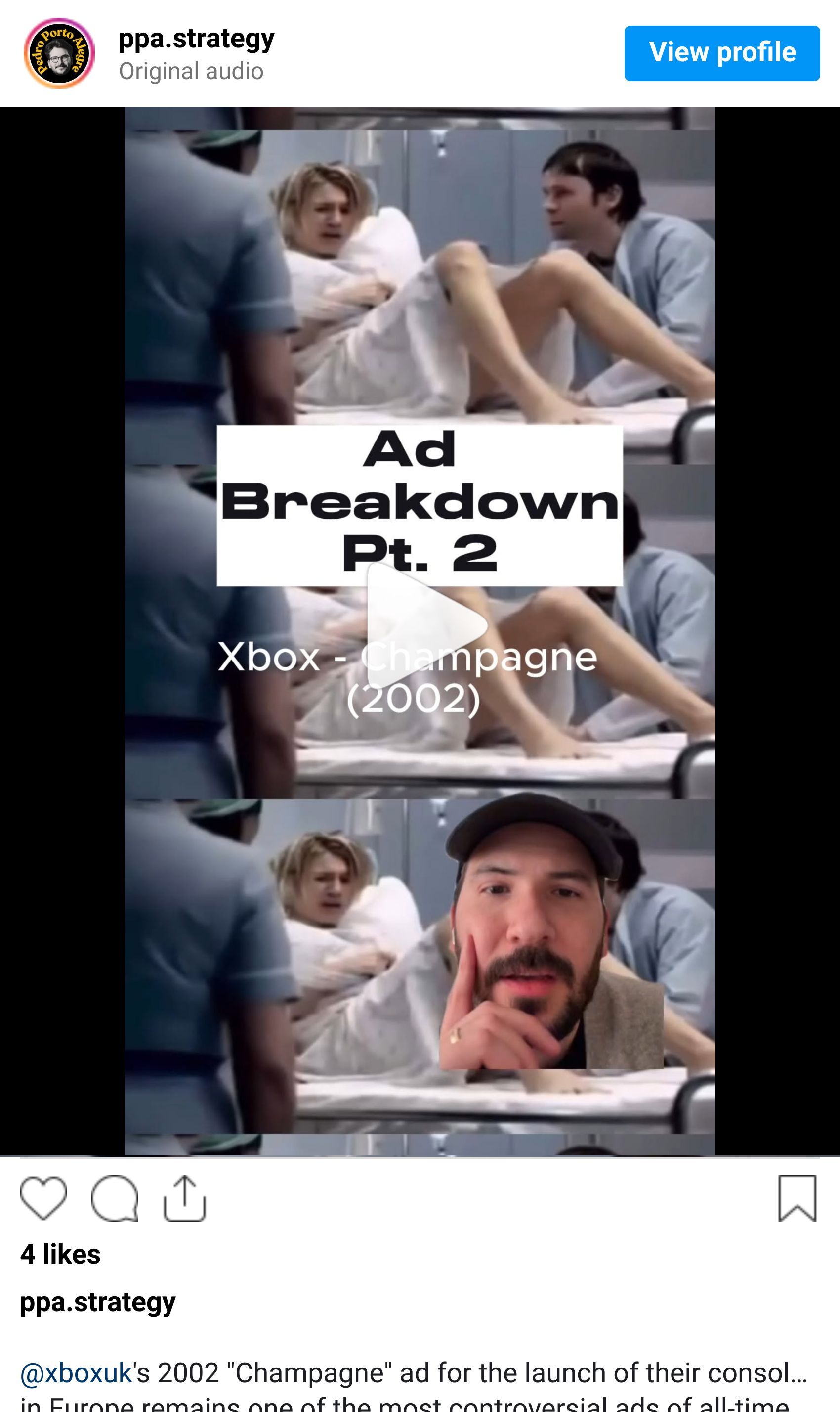
Xbox’s “Champagne” (2002)
Xbox's 2002 "Champagne" ad (done by BBH London) for the launch of their console in Europe remains one of the most controversial ads of all-time (it ended up receiving 136 complaints, and was banned on 3 months after going live).
And yet it also is one of the best pieces of work from the past 25 years.
Long, unbranded, and absurd - at face value, sounds like work from a parallel universe, and yet it's able to get away with it.
What do you think of this spot?
PS: "Ad Breakdown" is a new segment on my Instagram page where I peel back the elements of an ad that make it great (or not). Follow me on IG to catch all of them!
BRAIN FOOD/
Strategist’s Delight (What’s On)
Book: The Scent of Time: A Philosophical Essay on the Art of Lingering (Byung-Chul Han)
Podcast Series: The Last Invention (Longview)
Documentary: The American Revolution (PBS)
TV Series: Death by Lightning (Netflix)
QUOTE/
On Moral Complexity
“A clear conscience is the sure sign of a bad memory.”
More of PPA:
🗣 For speaking engagements, you can reach me at [email protected]
PPA
Pedro Porto Alegre is a seasoned marketing strategist with in-depth experience building brand and communications strategies for top-tier B2C and B2B organizations across North America. His repertoire extends from crafting and executing integrated multi-media brand marketing campaigns to the commercialization of performance-driven innovations for multimillion-dollar and nascent brands alike.
