
Welcome to Marketing Chronicles. A monthly dose of strategy and creativity for brands, agencies, and businesses — delivered on the second Wednesday of every month. If you like what you see and you’re not already a subscriber, join us for free.
Hello Marketing Chroniclers. This month we’re going back to the basics… of thinking.
The past 3 years have sent us down a path that’s becoming increasingly difficult to turn back from: our over-reliance on AI to think.
It’s time we have a conversation about our intellectual sovereignty.
Drop me a line on LinkedIn if anything stands out to you!
Enjoy 🧠
This edition is supported by Tracksuit, a beautiful, affordable, always-on brand tracking dashboard that helps marketers and agencies prove the impact of brand building.
I’ve always found that setting SMART brand objectives to be difficult without having a clear baseline of where my brands stand — until now. The folks over at Tracksuit have developed an elegant tool that helps you understand how your activities are impacting your brand's health metrics without breaking the bank.

BRAND STRATEGY/
Be More Like A Platypus, And Less Like A Moth
When auditing a brand, nothing worries me more than when consumer perceptions of it are around lukewarm terms such as "good", "ethical", "reliable", "modern".
These are the equivalent of consumers saying "I can't think of anything."
Brand positioning is one of the cornerstones of brand strategy (the others being targeting and objective-setting). But far too often, brands will either fall into a positioning unintentionally, or come up with it haphazardly.
Great positioning for it to hold any water has to pass the 3Cs test:
Can we credibly deliver on it
Do consumers actually want it
Can we do it relatively better than our competitors
That's why terms such as "good" and "ethical" are not all that great (despite being things worth aspiring for).
Another common mistake I see are massively long positioning statements.
Remember, consumers don't think about brands all that often, so we need to be crystal clear about the 1-2 things we want them to remember about us.
I typically stick to positioning pillars because they are memorable enough that internally everyone can recite it, and flexible enough that we can bring it to life with creative latitude.
And this brings me to my final concern about positioning.
It isn't all about differentiation.

Platypuses are so distinct that you know when you see one. Moths, on the other hand, are often mistaken for butterflies.
Differentiation nowadays is incredibly difficult to reach without IP.
If you've come up with a differentiated offer that's amazing, competitors will copy it in no time.
Instead, go for distinction.
Your brand codes (think of it as your brand's look and feel) are arguably the most important things you put out there. And it's ok for them not to make any sense (like a chubby marshmallow-looking man supposedly made of tires).
A.I./
How To Co-Think With AI
There’s a lot of talk right now about “using AI for strategy.”
Most of it quietly hands over the hardest part: the thinking.
This is the approach I’ve found works best, not to replace judgment, but to sharpen it.

Co-thinking with AI.
Start the thinking yourself
Before I touch AI, I write. Messy. Unfiltered.
Not to sound smart, but to see what I actually think.
I pay close attention to what feels odd, unresolved, or slightly uncomfortable. That’s usually where the interesting territory lives.
From there, I form early hypotheses about what’s happening, not what to do about it.
Use AI as a research engine, not a brain
Only after that do I bring AI in.
I ask it to run deep secondary research to fill my blind spots.
Then I go back to my notes and write headlines: short, compressive statements that force clarity.
Headlines are underrated. They collapse complexity into something you can argue with.
Hypotheses get refined. Some survive. Some don’t.
Stress-test, don’t validate
Next, I upload my refined hypotheses and ask AI to attack them.
Counter-arguments. Different angles. Assumption stress tests.
Not to be “right”, but to see where the thinking is brittle.
Back to the headlines. More context. More refinement.
Write the diagnosis
Now comes the synthesis.
I explain succinctly what I think is happening, supported by evidence.
Each headline becomes a pillar holding up the diagnosis.
I end with a direction, not false certainty, and I’m explicit about what still needs exploration.
Edit with AI, not through it
Only at the very end do I ask AI to edit.
Not to change the thinking.
Just to improve coherence, flow, and readability.
The result:
An evidence-based point of view that’s co-created with AI, but clearly led by human judgment.
And that’s the difference between using AI as a shortcut vs using it as a force multiplier for real thinking.
SODA 2.0/
The Positioning Dilemma In Emerging Categories
Raise your hand if you owned a Benetton sweatshirt in the 90s 🙋♂️
So much of their notoriety came from boldly taking a stance within polarizing topics in culture. And though that type of marketing has been overused in recent decades, its strategic underpinnings remain timeless.

Soda 2.0 is taking over the world by storm.
Poppi, Olipop, Evolution Fresh, Halfday, Culture Pop, Cove...
So many amazing brands are shaping this emerging subcategory.
But with it, an interesting problem is presenting itself:
Because of the nature of an emerging sub/category, brands will often position themselves in line with the novelty of it: probiotic, healthy, gut-friendly, etc.
And when everyone is assuming the same positioning, they all start to look and sound the same, all the while the category grows in fame (this is your classic grow the pie, not your share of it, case).
While there's plenty of dollars to go around in a growing sub/category like Soda 2.0, the bigger players (like Poppi and Olipop) will be the disproportionate benefactors of it (this is in line with the double jeopardy law).
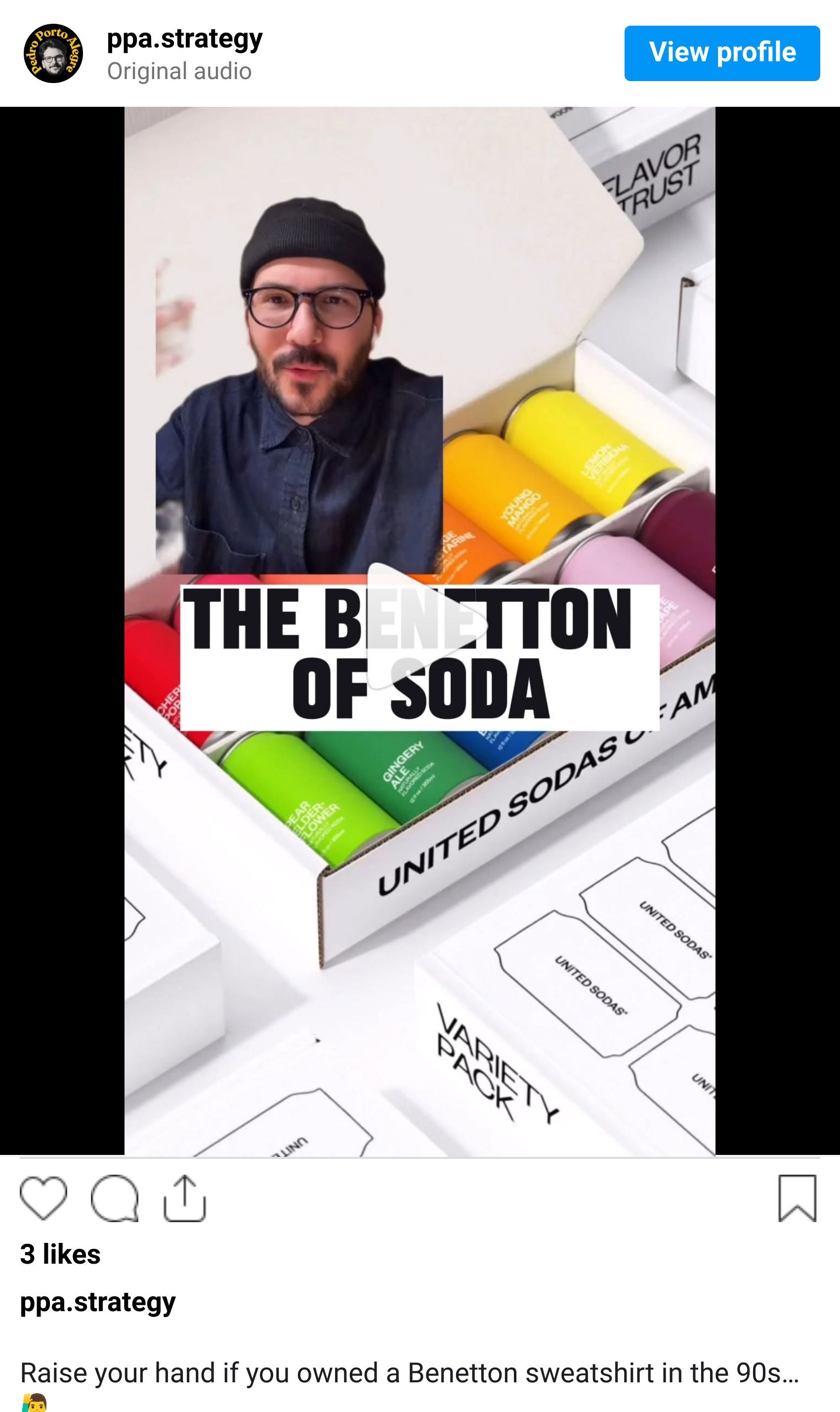
So, I present you United Sodas of America (or how I like to call them, the Benetton of soda).
They are a minimalist-looking soda that is trying to rescue "gut soda" from becoming medicine.
And yet, their distinct positioning remains largely undefined in the minds of consumers because of a simple problem: according to Tracksuit data, only 1% of consumers in the US have heard of them.
Check out my full deep-dive here if you want to learn more about how challenger brands can claim their portion of the pie in a growing category.

Click here to read: How United Sodas Can Win the Soda 2.0 Moment (Before It Gets Outshouted)
OPINION/
It’s Time To Unhack Ourselves
I've always had an allergy to the term "growth hacking."
It always sounded lazy to me, like as if you weren't willing to put in the time and commitment to actually see the fruits of the process itself materialize.
So much of the benefit of hiring an agency to work on your advertising campaign is the process of getting there in itself.
The conversations, the pressure tests, getting used to the uncertainty of novel ideas, the creative exploration and thinking about your brand in a different light. Stronger bonds emerge from that.
But "growth hacking" skips all of that.
It promises to get you from A to B in the least amount of time and effort.
The focus is all on the outcome, and because of that so much is left on the table.
Humans are naturally lazy beings - I get that.
Our brains are wired to expend the least amount of energy to accomplish an unit of task.
That's why you don't "think" about how to turn a doorknob - your brain's heuristics allow you do it on autopilot.
But, while productivity hacking was something that was more focused on implementing processes with intention, somehow that expanded to hacking our bodies, our relationships, our marriages, our thinking... nothing was off the table for growth hackers.
We're now even seeing people hack their own thinking by passing it off to chatgpt. Once we give that up, what's left?
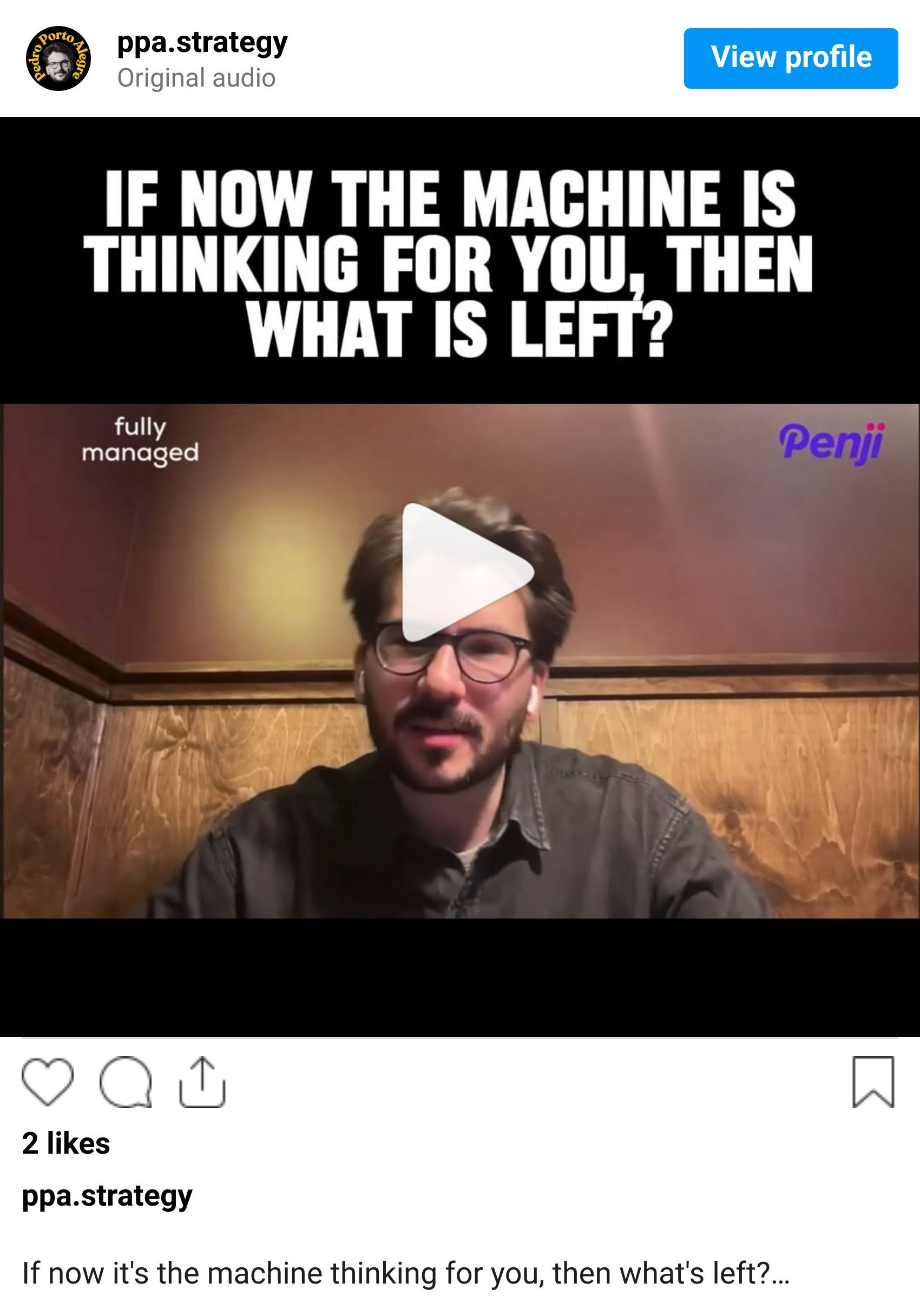
What ever happened to doing things with intention? With care?
To doing things that change us in the process of doing them?
What's all this rush we're constantly in?
I truly hope that "unhacking" ourselves becomes a thing one day.
And that the appreciation for slowness, consistency and patience becomes more common once again.
Good things take time.
INSPIRATION/
A Patriotic Ad In Unpatriotic Times
Budweiser has absolutely nailed their Super Bowl ad this year.
It not only conveys a positive message of what “being American” is all about (helping those in need, protecting those who can’t protect themselves, and helping them flourish and achieve their full potential), but it also does so in an exceptionally branded way.
You immediately know it’s a Budweiser ad from the start when you see the foal running in a pasture. Then the Americana kicks in full gear with Lynyrd Skynyrd’s “Free Bird” playing in the background, as that little bird grows into a full blown majestic bald eagle taking flight off the horse’s back.
It scored a near-perfect 5.6 stars in System1’s ad testing platform (the maximum is 5.9).
This will be a tough bar to clear by other brands this year. Let the games begin!
BRAIN FOOD/
Strategist’s Delight (What’s On)
Book: Twilight of Democracy (Anne Applebaum)
Podcast Episode: The Sharp Cut - Personas, We Have A Problem (Sleeping Barber Podcast)
TV Series: Drops of God (Apple TV)
Film: Anniversary (Pay to stream)
QUOTE/
“In any category there are some people who behave like homo economicus, and you don’t want them as customers. Focusing your business to appeal to your most economically rational customers is actually a recipe for disaster. Everything gets commoditized and doubled down to the lowest common denominator.”
More of PPA:
🗣 For speaking engagements, you can reach me at [email protected]
PPA
Pedro Porto Alegre is a seasoned marketing strategist with in-depth experience building brand and communications strategies for top-tier B2C and B2B organizations across North America. His repertoire extends from crafting and executing integrated multi-media brand marketing campaigns to the commercialization of performance-driven innovations for multimillion-dollar and nascent brands alike.
