
Welcome to Marketing Chronicles. A monthly dose of strategy and creativity for brands, agencies, and businesses — delivered on the second Wednesday of every month. If you like what you see and you’re not already a subscriber, join us for free.
Hello Marketing Chroniclers.
This month I want to share some personal advice on the value of being an outsider. I have always been skeptical of putting people who know a category super well on a project because they come with baggage from their past experiences in it. Seeing things through a beginner’s eyes is incredibly difficult to sustain over the years, but I want to challenge all of you to find ways to remain “outside the fishbowl” for as long as you can.
Drop me a line on LinkedIn if anything stands out to you!
Enjoy 🧠
This edition is supported by Tracksuit, a beautiful, affordable, always-on brand tracking dashboard that helps marketers and agencies prove the impact of brand building.
I’ve always found that setting SMART brand objectives to be difficult without having a clear baseline of where my brands stand — until now. The folks over at Tracksuit have developed an elegant tool that helps you understand how your activities are impacting your brand's health metrics without breaking the bank.

ADVICE/
Outside Of The Fishbowl POV
Strategy attracts certain types of people. They're typically quieter, introspective, and a bit of misfits.
For years I struggled with finding a profession that could bring the best out of me, and if you're stuck in this same dilemma, don't stop looking!
Growing up in Brazil I've always felt somewhat like an outsider: in a country where everyone played soccer, I fell in love with basketball; in the busy streets of Sao Paulo where everyone was trying to get somewhere, I was always looking for spots to skateboard with friends; as an eventual expat, coming back home made me notice the sounds, colours, and environment that most took it for granted.
While at the time those things made me feel dislocated, in hindsight those moments were invaluable for my formation.
I've come to realize that this feeling of seeing things from "outside of the fishbowl" is actually quite common among my strategy peers. This is our super power.
We might not be the loudest, most talkative, and extroverted people (in general), but we are able to bring an ingredient to the mix that very few can.
Great teams are composed of people who complement one another, so it would be a shame if we all aimed to behave alike and excelled at the same things.
Be humble. Stay hungry. Keep learning new things.
To me, that's the common denominator. The rest is all upside variability.
But most importantly, as you're looking to find your footing: embrace who YOU are.
Great things lie on the other side of self-acceptance.

Pedro Porto Alegre at a speaking event at the University of Calgary.
DEPT. OF HONESTY/
Why Level-Setting Objectives Is The First Step To Overachieving
Setting objectives for a business is one of the trickiest activities there is.
Too often, businesses will set insanely ambitious objectives, when they can't even do the fundamentals properly first - that's just a window-dressing exercise at that point.
One way to look at it, is by being honest about where your business is at.
In the book "Good Strategy, Bad Strategy", there's a great example that Richard Rumelt gives about how helicopter pilots go from learning how to lift the thing off the ground to eventually operating it in combat missions.
Operating a chopper involves a lot of simultaneous tasks that one must worry about. Before one can fly at night, they must first learn how to fly during the day. Before one can land in mountainous terrain, one must first learn how to land in a cross-winds environment. Before one can fly into combat, one must first learn how land in a moving naval ship in choppy waters in the pitch dark.
These are gradual steps that helicopter pilots must master before they can take on increasingly more ambitious challenges.

There are gradual steps that helicopter pilots must master before they can take on increasingly more ambitious challenges.
The same goes for businesses.
Before a brand can begin thinking about "tracking which distinctive brand asset to invest in vs pull money from, while directing resources into strengthening associations with X category entry point", they must first have the right resources, talent, and culture in place within their organization.
One simply does not go from "increasing awareness" to that overnight.
The Big Mac Index has always fascinated me because the financial section of The Economist is often mind-twisting for me. Many of the concepts discussed there are geared toward investment bankers and CFAs. So, as a marketer, the Big Mac Index is one tool that helps me "pilot my chopper" through those waters.

The Big Mac Index. The Economist.
This is a brilliant comms solution that the folks at The Economist found to expand their readership beyond their core target audience.
They're great at level-setting the bar and meeting you where you're at.
For businesses looking to grow, being honest about which rung of that ladder their organization is at isn't an admission of failure: instead it's a strategic step in getting your company to master the fundamentals before flying into increasingly more ambitious territories.
HOW BRANDS GROW/
The Simple Math Behind Growing A Brand
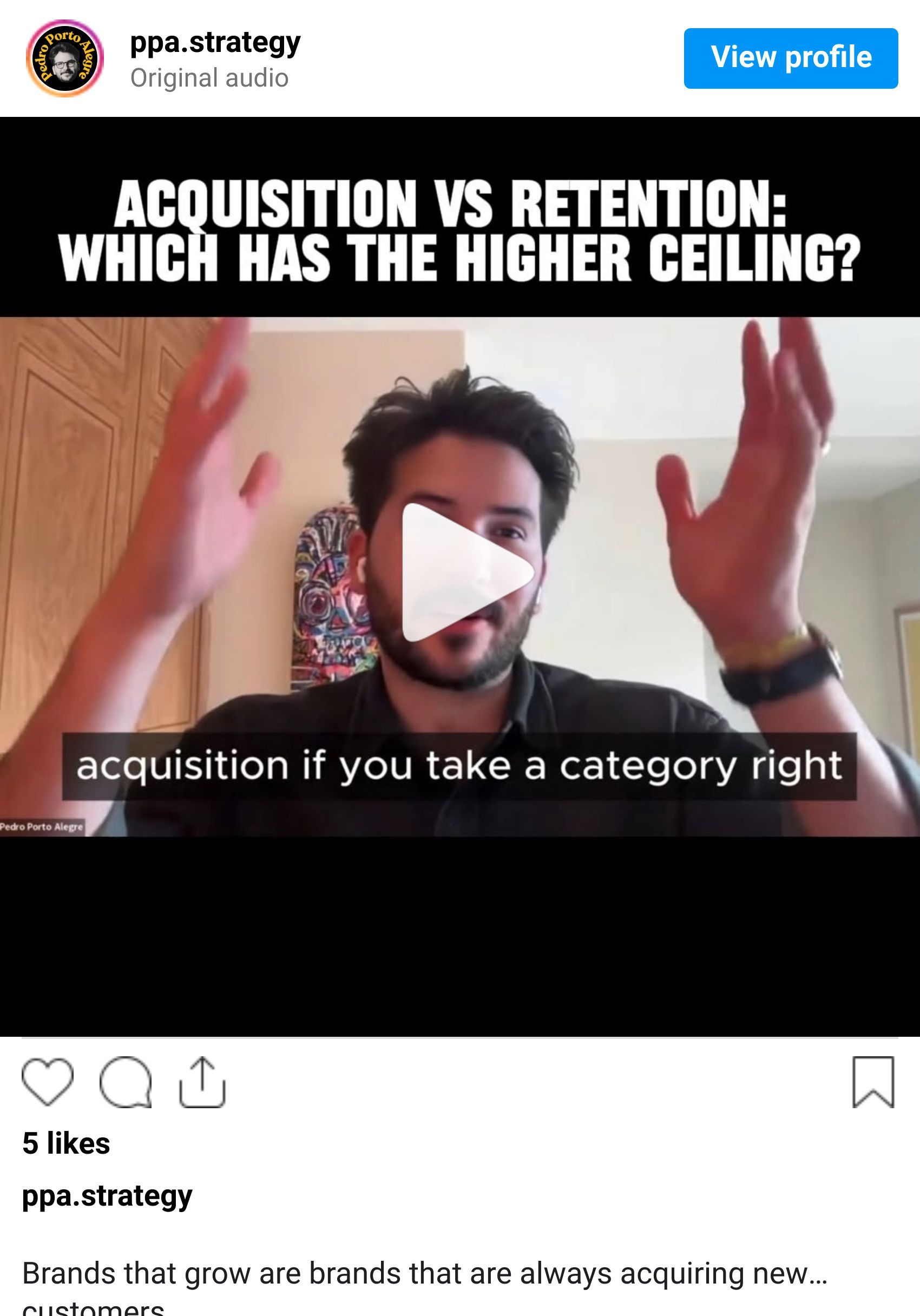
Brands that grow are brands that are always acquiring new customers.
Retention, while important, can only take you so far. Let's dive in:
Most categories have a long tail of customers - meaning, a small percentage of heavy users (aka, high purchase frequency) and a much bigger percentage of light buyers (aka, those who buy the category one time or less per sales cycle).

Source: “The unbearable lightness of buying, as told by an old jar of pesto”. Ehrenberg-Bass Institute.
This means that at any given point, the number of category buyers "up for grabs" is immensely larger than the number of customers who already buy from you.
Another critical fact here is that brands experience very similar percentage numbers of churn (aka, the percentage of customers who you lose every sales cycle). This is typically dictated by category norms for a variety of factors such as shared CEPs, physical/mental availability overlaps, stable buying repertoires, overall buyer behaviour, and more.
Take the following example:
Category X has an average churn of 10%
Brand A has 1,000 customers and loses 100 customers per year
Brand E has 10 customers and loses 1 customer per year

If you're Brand E should you focus your budget on retaining the 1 customer you lose, or on acquiring the 100 customers lost by Brand A who are now up for grabs?
These insights have two major implications:
In order to grow, brands need to continually drive their market penetration to reach light buyers.
Absolute retention (not % retention) is derivative of how big your brand is.
This doesn't mean that retention is something to be ignored - on the contrary, if your product/service sucks but you're growing market penetration, all you're doing is speeding up your rate of failure.
Once people try your brand and the experience is bad, they not only won't come back, but if it's really bad they will spread negative word of mouth.
Therefore, aligning your budget spend between acquisition and retention isn't an exercise of absolutes - instead it's a balance based on empirical realities of the category you operate in.
BRAND ARCHITECTURE/
The Strategic Substance Beneath Brand Hierarchy Trees
Brand architecture is one of the most strategic exercises a marketer will ever engage in. But drawing up a brand hierarchy tree is NOT inherently strategic.
There's a lot of work that needs to be done BEFORE they take shape.
For starters, there are more visual models than brand hierarchy trees that might serve your organization's needs better.
But unfortunately that's just what you see when you Google "brand architecture."

Here’s a screenshot of what images you get in Google when you type “brand architecture” into the search bar.
Secondly, brand portfolio strategy isn't reserved only to the big players.
If you're a growing brand, you need to start thinking about new product development, limited time offers, and co-branding opportunities.
While the issue is typically the other way around (managers being too eager to launch new properties without rhyme or reason), brand alliances are often overlooked in the scale up stages. These are some of the most effective growth tactics most brands could be engaging in right now.
Finally, your portfolio needs to serve the needs of the BUSINESS.
You do this by aiming for clarity, differentiation, energy, leverage and relevance.
If you'd like deeper dives into brand portfolio strategy than the deck above, check out a couple of evergreen articles I've written on the topic below:
INSPIRATION/
Warburton’s 150 Years in the Baking
Look, I had never heard of this bread brand (probably because I don’t live in the UK), but after watching this ad I want to try their bread.
For one, they got Morgan Freeman to narrate their spot.
Secondly, I never thought watching a commercial about bread could be so entertaining.
Finally, this passes with flying colours on System1’s test my ad platform.
5.2-Stars. 94% Brand Fluency. Wow.
BRAIN FOOD/
Strategist’s Delight (What’s On)
Book: The Copy Book (D&AD)
Podcast Episode: The Decision Factory: AI’s Missing Manual. With Roger Martin (Sleeping Barber Podcast)
TV Series: Dynasty: The Murdochs (Netflix)
Film: The Report (Amazon Prime)
QUOTE/
Never Go “Ready, Fire, Aim”
"Never go 'Ready, Fire, Aim.' If you do, you'll always shoot yourself in the foot. Instead, consider the more familiar cycle 'Ready, Aim, Fire'. 'Ready' takes a second. 'Fire' takes a fraction of a second. But it's the 'Aim' part that's most crucial, that can seem interminable, with all the squinting, steadying, and just when you think you've drawn the exact right bead, you waver and have to begin all over again”
More of PPA:
🗣 For speaking engagements, you can reach me at [email protected]
PPA
Pedro Porto Alegre is a seasoned marketing strategist with in-depth experience building brand and communications strategies for top-tier B2C and B2B organizations across North America. His repertoire extends from crafting and executing integrated multi-media brand marketing campaigns to the commercialization of performance-driven innovations for multimillion-dollar and nascent brands alike.
